
AI at work in 2026: what's actually changing beyond the code editor
AI's workplace impact goes far beyond coding assistants. Here's how AI is reshaping healthcare, law, finance, HR, and operations — and what researchers predict for 2026.
Updated
TL;DR
- AI’s biggest workplace impact is not in coding. It is showing up in healthcare, legal, finance, HR, customer operations, and manufacturing.
- McKinsey’s 2025 data shows 88% of organisations use AI in at least one business function, with strong adoption in marketing, customer service, and operations.
- Anthropic’s March 5, 2026 labor-market analysis highlights the key gap: model capability is ahead of real-world workflow adoption, but that gap is closing.
- The next step is from chat assistants to delegated systems that can act inside bounded workflows across devices and tools.
- The main 2026 pattern is task transformation, not mass job replacement. Governance, access control, and auditability are becoming core infrastructure.
When people talk about AI at work, they usually talk about code: copilots, IDE assistants, generated pull requests.
That misses where the broader shift is happening.
AI is already changing work in healthcare, law, finance, HR, customer operations, and manufacturing. It is drafting notes, reviewing contracts, flagging fraud, screening applications, triaging support requests, and predicting equipment failures. Those use cases get less attention than coding demos, but they affect far more workers.
Anthropic’s March 5, 2026 report, Labor market impacts of AI: A new measure and early evidence, is useful because it separates what models could do from what organisations are actually using them for in production. That distinction matters. The constraint in 2026 is usually not raw capability. It is trust: workflow design, approvals, integrations, and governance.
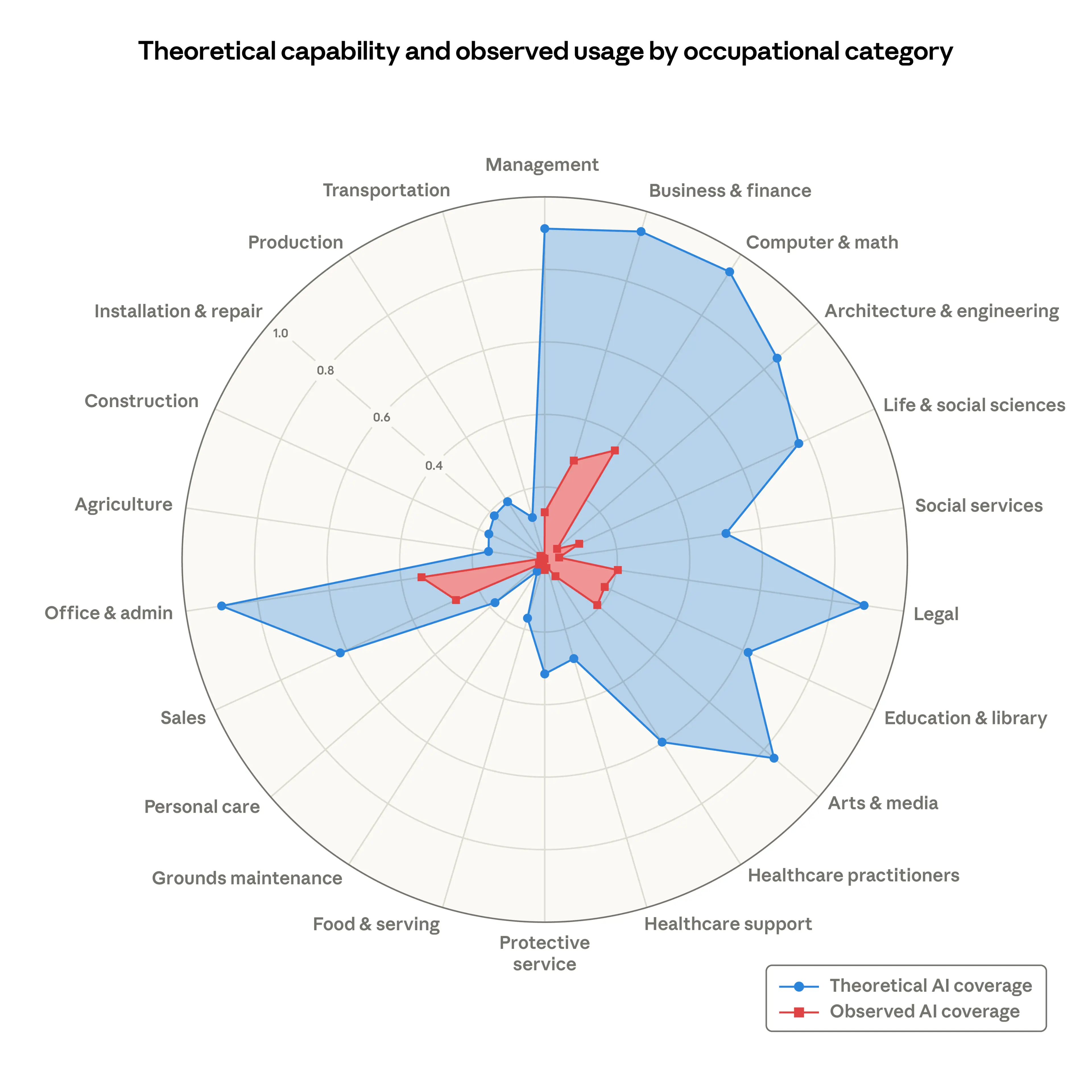
Anthropic’s Figure 2 makes the point clearly: many white-collar occupations already have high theoretical AI exposure, but observed usage still trails. The competitive advantage is no longer just access to a strong model. It is the ability to operationalise that model inside real systems.
That is why the 2026 story is shifting from “better chat” to delegated execution. Products like Claude Dispatch in Cowork and Perplexity Computer point in the same direction: persistent context, tool use, and bounded task execution across devices. They are not all fully autonomous, but they show where the market is going.
Where AI is reshaping work now
McKinsey’s 2025 Global AI Survey found that 88% of organisations use AI in at least one business function. The fastest-growing areas were marketing, service operations, and product or service development, with steady growth across supply chain, finance, HR, and legal.
That matters because the workplace story is no longer “engineers use AI.” It is “business functions are redesigning routine work around AI.”
Healthcare
Healthcare is the clearest non-coding success case.
Ambient clinical documentation tools such as Nuance DAX Copilot, Abridge, and Nabla reduce time spent on notes by transcribing and structuring consultations in real time. Diagnostic imaging systems are already assisting with radiology and pathology workflows, and AI-driven drug discovery has moved from hype to real pipeline value.
The pattern is consistent: AI is not replacing clinicians wholesale. It is reducing administrative load and improving decision support where pattern recognition matters.
Legal
Legal teams are using AI for contract review, research, and first-draft generation. Tools such as Harvey, Luminance, and Kira speed up clause analysis, surface risks, and compress the time required for routine review.
But legal is also where governance becomes impossible to ignore. Privileged information, matter isolation, and auditability are not optional. A law firm that adopts AI without strict data boundaries creates immediate regulatory and reputational risk.
Finance
Finance has quietly become one of the most mature enterprise AI sectors.
Fraud detection, risk assessment, compliance monitoring, and back-office automation are already established use cases. Banks and payment networks use AI to score transactions in real time, reduce false positives, and flag anomalies faster than human teams could manage alone.
This is not a futuristic use case. It is live operational infrastructure.
HR and customer operations
HR is using AI for screening, onboarding, internal knowledge support, and retention analytics. Customer operations is using it for triage, response drafting, and routine issue resolution.
Both functions show the same tradeoff: strong productivity upside, high governance stakes. In HR, bias and transparency are central. In customer service, the best systems resolve routine work quickly and escalate emotional or high-stakes cases cleanly to humans.
Manufacturing and logistics
In manufacturing, the value is prediction over reaction: predictive maintenance, computer-vision quality control, and supply chain optimisation.
These are narrow systems with clear economic value. They do not look like general-purpose chatbots, but they are exactly the kind of AI deployments that change operating models at scale.
What 2026 likely looks like
The research consensus is narrower and more practical than most AI discourse.
1. Task transformation beats job replacement
The strongest finding across major studies is that AI changes tasks within roles faster than it eliminates entire roles.
The World Economic Forum’s Future of Jobs Report 2025 projects that 39% of core work skills will change by 2030. Goldman Sachs estimated that fewer than 7% of roles are likely to be fully automated, while a far larger share will be significantly reshaped. OECD analysis makes the same distinction: exposure to AI does not equal disappearance.
For most workers, the near-term shift is not “AI takes the job.” It is “AI takes the routine part of the job.”
2. Productivity gains are real, but uneven
The productivity evidence is now credible. Studies from Stanford and MIT on customer support, alongside broader labour-market analysis from PwC and others, show measurable gains, especially for less-experienced workers.
But those gains do not arrive automatically. Many organisations still fail to realise ROI because they bought tools without redesigning processes, training teams, or defining where AI is actually allowed to act.
Anthropic’s capability-versus-coverage framing sharpens the point: economic value comes from the tasks an organisation has operationalised deeply enough to trust.
3. The interface is shifting from chat to assignment
Recent products suggest 2026 is the year AI moves from passive assistant to delegated worker.
Claude Dispatch extends task execution across devices with persistent context. Perplexity Computer pushes further toward long-running, asynchronous task execution. Infrastructure vendors are also converging on the same destination: agents that can monitor state, use tools, and operate within explicit policy boundaries.
The difference between products is still large. Some are human-triggered and session-bound. Others are designed to persist much longer. But the direction is clear: less “ask AI a question,” more “assign AI a piece of work.”
4. Governance becomes runtime infrastructure
As AI moves into legal, HR, finance, and customer operations, governance stops being a policy document and becomes a system requirement.
The priorities for 2026 are straightforward:
- data boundaries between teams and tools
- access control over what the agent can see and do
- audit trails for decisions and actions
- runtime guardrails for persistent agents
This matters even more as “shadow AI” spreads. Once employees are already using unsanctioned tools, the winning move is not pretending adoption can be stopped. It is providing sanctioned systems that are safer and more useful.
What becomes more valuable for humans
If AI absorbs more routine cognitive work, human value shifts upward.
The capabilities that matter more in 2026 are contextual judgment, critical evaluation, process design, stakeholder communication, and ethical reasoning. In other words: domain expertise still matters, and in many settings it matters more.
The worker who benefits most from AI is usually not the one who writes the fanciest prompt. It is the one who knows where the system is useful, where it is unsafe, and how to fit it into real work without lowering quality.
Key takeaways
The coding-assistant narrative is too narrow. The larger workplace transformation is happening in operational functions that rely on repetitive cognitive work, structured decisions, and high volumes of documentation.
The main lesson from 2026 research is not that frontier models alone will change everything. It is that organisations win when they turn model capability into trusted workflow execution.
Three things separate serious adopters from everyone else:
- They deploy AI into specific, bounded tasks.
- They build governance into the runtime, not as an afterthought.
- They develop human judgment alongside the tooling.
The important question is no longer whether AI can do more work. It can. The real question is whether your organisation can let it act safely inside the systems that matter.
At Oort Labs, we help organisations build the governance and security infrastructure that makes enterprise AI deployable at scale — with data boundaries, access controls, and auditability built in from the start. If you’re navigating this transition, we’d like to talk.
FAQ
Is AI really transforming jobs outside of tech?
Yes. Some of the strongest production use cases are in healthcare, finance, customer operations, and legal. They are less visible than coding tools, but often more operationally important.
Will AI replace my job?
Most research points to task replacement before job replacement. Some roles will shrink or disappear, but the dominant near-term effect is job redesign rather than wholesale elimination.
What skills matter most?
Contextual judgment, domain expertise, critical evaluation, process design, and communication matter more than prompt tricks. The value is in directing and verifying AI, not just using it.
What is changing in 2026 specifically?
Enterprise AI is moving from experimentation to operationalisation, and from chat interfaces to delegated task execution. That raises the value of governance, permissions, and auditability just as much as model quality.